What readers are saying about Jim's book...


"With profound insight, compassion, and solid biblical support, Jim resurrects one of the most forgotten and overlooked truths in our day."

~Dwight Edwards, author and advisor to Larry Crabb


"Still the best book on the theme out there."

~Alice F.; Arizona

*Read more reviews on Amazon...

Prone To Wander Myth

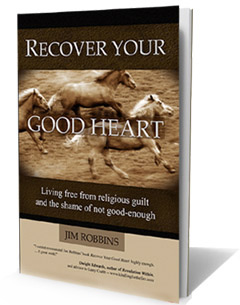
Buy Jim's book.

 What if your heart is no longer 'prone to wander?'  What if God is more interested in releasing a noble goodness He's already placed within you, rather than pressuring you to be more 'holy?'  Discover the book by Jim Robbins.

good and noble heart resources


Get Jim's Newsletter

LISTEN OR WATCH
CONTACT JIM
Follow this blog.
Search this blog


Entries in Reading (3)

Friday
Aug272010

Books I recommend

The following books take the idea of the Christian's good heart seriously. 
I highly recommend them:

by Larry Crabb
................................................


by Dwight Edwards
................................................

by Andrew Farley
................................................


by Stone & Smith

What books do you recommend that take the Christian's good heart seriously? [Post a comment below.]


Related posts:

"How to Shame a Christian"  - video

"As the heart goes, so goes a life."


Monday
Mar302009

Survival Tool - Building a memory library

Held hostage for 1,967 days in the Columbian jungle.

The plane that was carrying the three American contract workers crashed in the dense jungles of Columbia.   Surviving the crash was only the beginning of what was to come.  Tom, Marc and Keith (and their pilot and Columbian co-worker) immediately found themselves in a hot zone ruled by the FARC -- a notorious terrorist organization known for kidnappings, drug trafficking, hostage-taking, and murdering innocent civilians. 

The FARC quickly swarmed out of the jungle towards the crumpled aircraft -- beginning Day One of a five-year plus captivity for the three men in the jungles of Columbia.  (The pilot and the Columbian on board with the three were immediately separated from the group.  Later, news reached the three Americans that their friends had been executed by the FARC.)

In order to cope with the dehumanizing madness of captivity, one of the American contractor hostages created what he called a "library of memories," a virtual collection of moments and recollections of his family back home, childhood memories, and pre-captivity life.  The FARC guerrillas could take away his freedom of movement, institute 40-day forced marches, put him in chains, or refuse him the right to empty his bowels in private, but they could not take away what was inside his head.  That "library of memories" was a virtual room he could walk into at any moment and pull a memory off the shelf. 

As I read their account, I was struck by how helpful this could be during moments or chapters of spiritual disorientation:  those times where God seems cruel or absent, and appears to be markedly silent; when what I hope for feels like it will never come.  So I created my own library of memories.  The "spines" on some of my titles read: 

  • Lynn -- Here She Is, Jim.
  • Olivia & Nate:  Gifts
  • Rafting Rescue
  • Chosen -- Len Sweet
  • Peterborough Confirmed
  • Dwight's Endorsement

When I forget the history of God's compassionate intervention in my life, I go to my library and pull off a title from the shelf.

What book titles would be in your "library of memories?"

Wednesday
Apr112007

Books I'm reading

Thought you might like to know what I'm reading these days:

1. I recently finished two books on wilderness adventure. (Suburban Florida offers little in the way of surviving avalanches, grizzlies, and cold, so I thought I'd read about others surviving such things.) Wild Men, Wild Alaska is written by a Christian outfitter-guide living in Alaska. Rocky McElveen dishes out fantastic and unbelievably true stories of Alaskan survival. He's danced with a charging grizzly and woken up to find wolf prints circling his tent.

The second book is called Deep Survival, by Laurence Gonzalez. Though the author doesn't allow for the rescuing hand of God in the stories he chronicles, he does a great job of explaining why some people live and others die in the wilderness or other high-stress situations.

2. I've also found Michael Card's A Sacred Sorrow very helpful. He argues, in contrast to much of the Church's teaching, that it is appropriate to cry out to God in our pain, even to accuse God. Card reflects upon the desperate, and seemingly irreverant cries of Job, David, Jeremiah, and Jesus. He asks us to recover the "language of lament" because in our lament and even accusations against God, a bridge is built from our hearts to his, allowing us to stay connected to him in our pain. Those who refuse to cry against God's seeming indifference and insist upon editing their grief actually are in danger of losing heart. Lament is an act of intimacy and connection.

3. I'm well into John Eldredge's most recent book, The Way of the Wild Heart. As a complimentary book to Wild at Heart, this new book gives men in our culture a path for masculine initiation. How do we help our young sons become men - in a way that they know they are authentic men? More than a description of meaningful ceremonies and initiation events, Eldredge provides a map for each stage of the masculine journey: from Beloved Son, to Cowboy/Ranger, to Lover, to Warrior, to King, and finally, to Sage.

4. I've just started Bill Mckibben's, Deep Economy. Don't let the title fool you: the book is more about genuine and sustainable community than economics. McKibben wisely insists that our western culture of 'more is better' will leave us in ruins, and ultimately won't give us what we most deeply want. He points us in a better direction so that "more" is replaced with better and more meaningful.

5. I'm currently reading God Is Closer Than You Think, by John Ortberg. I respect Ortberg, not because he was a former teaching pastor at Willow Creek, but because he's very well read. He's a great storyteller and sees below the surface of pop Christianity.