







Friday
Apr232021
VISIT NEW WEBSITE!
 Friday, April 23, 2021 at 1:37PM
 Hello! I no longer post here. Please visit my new website at www.jimrobbinsofficial.com to explore both my writing and music. Thanks for visiting.


"With profound insight, compassion, and solid biblical support, Jim resurrects one of the most forgotten and overlooked truths in our day."
~Dwight Edwards, author and advisor to Larry Crabb
"Still the best book on the theme out there."
~Alice F.; Arizona
*Read more reviews on Amazon...
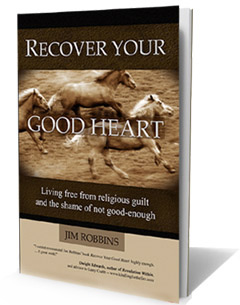 What if your heart is no longer 'prone to wander?' What if God is more interested in releasing a noble goodness He's already placed within you, rather than pressuring you to be more 'holy?' Discover the book by Jim Robbins.





Friday, April 23, 2021 at 1:37PM Hello! I no longer post here. Please visit my new website at www.jimrobbinsofficial.com to explore both my writing and music. Thanks for visiting.
Sunday, April 7, 2019 at 10:48AM 
We all know the conversational hijacker. This person hijacks your story in order to talk about themselves. They leave your story by exclaiming, “The same thing happened to me, too;” then proceed to turn the attention from you to them. Your pain just became an opportunity to talk about their pain.
It’s easy to shanghai another person’s story by using it to talk about our experience; especially when theirs sounds so similar to ours; but doing so forces the hurting person to take care of us now. Sharing our own experience too quickly doesn’t always build a bridge to them as we imagine it would.
When engaging another person, stay in their story. Don’t hijack their story to talk about yours.
"Push the arrow:" the antidote for The Hijacker
This idea is from Adam McHugh; The Listening Life. McHugh asks us to imagine a large arrow hovering in the space between us and the other person. The arrow will always swivel towards the person who is getting the attention. McHugh say, "So, as the listener in this conversation, your goal is to keep the arrow pointing at the other person for as long as possible." Make the conversation about them. The arrow will always want to return to you, however, so pushing it towards the other person requires vigilance.1
Push the arrow.
1. The Listening Life, Adam S. McHugh; p. 143
Thursday, April 4, 2019 at 11:50AM

If you listen deeply so that others feel seen, heard and honored, you are a "force multiplier."
In the military, snipers on over-watch are called, "force multipliers" because they guard the forward advance of ground troops, insuring that an area is cleared of enemy presence prior to the arrival of ground forces. The sniper is "multiplying" the force or effectiveness of the ground troops by caring for their safety.
When people feel more securely grounded because of your focused attention, you are multiplying their effectiveness, or force strength. You are mending the broken heart that their own life and ministry flows from. As they heal, their force effectiveness multiplies.
Souls repair through listening. According to Robert Logan, the word "equip, as in "equipping the saints for ministry," can mean, "put into working order," or in other places, "repair." In classical Greek, "equip" can mean, "the setting of a broken bone." (Thanks to Father Andrew of HeartSync Ministry for the reference here.)
Those who help others feel well-heard are Force Multipliers who "equip the saints for ministry." When you listen deeply, you are Force Multiplier.
Friday, March 15, 2019 at 12:01PM 
The burned ash of falling buildings covered their faces. Eye sockets and foreheads were smeared in grey soot. Eye lashes were gritty with airborne particulate, and ears stuffed with cinder. Only the skin where their medical face masks were tied on showed pink at all, having escaped the swirling ash from the World Trade Towers.
Morning after morning the ferry took the workers, traumatized into silence, to Ground Zero. It was on the Staten Island Ferry, serving as a transport for workers in the aftermath, that the chaplain noticed the woman.
Despite the soaring temperatures that day, the frightened woman wore a fur coat. She was maternal-aged; perhaps 40-something. Draped in jewelry, she murmured aloud to no one in particular. Clutching something in her pocket, she muttered like a mad woman, "I'm not going to let them get us again. I'll just put some of this in my daughter's milk while she's sleeping. She'll never feel it. Then some for me. I'm not going to let them do this to us again."
The chaplain was rightfully frightened by her intent. Feeling compelled, but having no idea what to say to this woman, the chaplain was suddenly distracted by a voice calling behind him, "Excuse me just a moment."
After only seconds passed, he turned back around. And she was gone.
The boat having just docked, he ran down the gangplank searching frantically for this woman because he knows that a baby will soon be poisoned, and her mother will commit suicide if she's not intercepted. Unable to find her, he approached the workers' tent where his comrades prepare for the day. Telling his story, the guilt-ridden chaplain confessed his failure to say something, anything, to the woman. They responded, "It's not your fault; it's okay. It'll be alright." Meager attempts to dampen the reality.
At this point, the tent flap opened and the missing woman walked into the tent. The woman spotted the chaplain and with a purposeful gait, walked right up to him declaring, "There you are. I just want to thank you so much for your advice. Thank you for telling me that what I was doing was insane. Look, here's the stuff; take it. Here's my card with my cellphone number. Come and visit. All is well; I'm just so grateful for the word you told me; how Jesus loves me," she says.
And with that, she walked out of the tent.
The stunned chaplain turned to his fellow workers and admitted, "I never said a word to that woman. All I did was listen."
[I heard Dr. Russ Parker tell this true story. I've done my best to recapture it here. The original account was written by a chaplain at Ground Zero. I'm unsure of the book's title. With thanks to Russ Parker; whose stories offer some of the best theology I've ever heard.]
Friday, November 23, 2018 at 3:05PM 
Safe people, "guard your trust as if it were money in the bank." - Dr. John Townsend
In the movie, The Horse Whisperer, a young girl and her prized horse, "Pilgrim," get hit by a tractor trailer truck, head on.
In order to protect his vulnerable rider, Pilgrim throws her off to the side seconds before the impact. But Pilgim is not as fortunate as his rider; he takes the full force of the truck's grill in the chest. He is thrown down the road; his flesh is sliced open, his psyche smashed. He is a trauma victim.
Trauma steals capacity: Capacity for trust. Capacity for connection. The horse has lost both.
The horse's one hope is Tom Booker, the "Horse Whisperer;" but rehabilitation will be slow. In a moment of triggered fright, "Pilgrim" breaks out of the round pen, to be found miles away at the long end of a distant field. Tom Booker responds to the distance with patience.
The horse is a footbal field away; so Booker sits down in the grass. And waits. He won't violate the horse's sense of safety.
When the time is right, Booker approaches Pilgrim by taking a few steps, less than the length of a car; then sits. And waits. Then more steps; more sitting. It takes all day to cover the distance of a football field, until Booker finally has permission to connect within arm's reach; in the horse's own space. Trust was earned in inches.
Safe people know your capacity to connect shrinks when you're processing a painful experience you can't metabolize. So they earn your trust inch by inch; for as long as it takes.
Thursday, February 8, 2018 at 2:03PM 
The best way to connect with another person so that they feel seen, heard and honored is to create safety. If emotional safety isn't a priority, the conversation will stay in the shallow end, and neither person will experience the bonds of connection a relationship can provide. So the number one priority of any conversation is to create emotional safety.
I'll offer a personal story here: In a counseling session, the therapist noticed I was "going to my head," lost in the analytical and cognitive part of my brain. I was using psychological lingo and talking shop with the therapist by mentioning a famous psychiatrist's view on trauma. My comment was relevant to my history, but was couched in analytical language that avoided the actual painful feelings underneath. I was retreating to my left-brain, while avoiding the emotional anguish trapped in my right brain.
Rather abruptly, the therapist stopped me, saying, "I don't want you to do that. I want the 'real you' to show up."
I shut down.
I understood the therapist's intent to help me access the emotional pain I was carrying; but by rushing too quickly to disengage that analytical protective mechanism I'd developed over decades, the therapist lost access to those very painful places he was trying to rescue. I no longer felt safe. Anxiety hijacked my entire body; the threat response for fight or flight took over and any therapeutic benefit evaporated.
The therapist didn't understand that by stripping me of my coping mechanism too early in the game, he kicked out the crutches from under my arms. And nothing better was offered to replace those crutches. Until a person's emotional legs begin finding strength, kicking the crutches out from underneath them is a bit like asking a toddler who's learning to swim to remove their "floaties," then throwing them into the deep end. They're not ready yet.
To his credit, this talented therapist realized what had happened when I pushed back a bit, and worked sincerely to rebuild that safety. Yet, some ground was lost nevertheless.
Honor the person's coping mechanisms. Remember that defense mechanisms developed for a reason: they once helped that person survive, or at least enabled them to handle terrifying or shaming events in their story. Though it's true that those defense mechanisms are now an out-sized, misguided response to pain, they once served a legitimate function.
If you try to challenge or remove misguided coping strategies too soon, you create a sense of threat, causing the person to retreat rather than remaining open to you. Yes, we hope that those misguided defense mechanisms will one day no longer be necessary--like my tendency to shift to analysis and reasoning when I can't "feel" my feelings--but those defenses don't get healed by direct challenge: they get healed through safety.*
Refrain from trying to change their mind too quickly. Don't quote Scripture in hopes they'll give up their false notions and maladaptive coping. At best, it will feel annoying to them; and at worst, it will feel threatening to those places that already feel threatened. You don't have to agree with a person to be present to them. It's the kindness of God that leads to change.
Stay away from hasty advice or attempts to help them "see the truth." They're not ready if you haven't earned their trust and safety; or if their pain is particularly acute. Safety takes time.
Rather than responding with judgemental or corrective language, say something like,
"I get why you'd feel so guarded and afraid. I get that nothing feels safe to you right now."
"I understand why you've kept those feelings pushed back; it never felt safe for you to express them."
Creating safety is the number-one priority in any conversation. Even confrontational ones. When you have safety, you have connection. When you lose safety, connection evaporates.
.......................
*Heart Sync Ministries, founded by Andrew Miller, trains its practitioners to go slowly, building safety every step of the way. They honor those protective mechanisms, which they call "Guardian" aspects of a person's identity. When functioning normally, those protective functions help us "guard our heart, the wellspring of life." When not overwhelmed, those internal protective features are a legitimate threat-detection system for us. Those fight/flight/freeze responses are very often necessary. They help give us a sense of whether that guy at the bar has good intensions, or that opening up to a particular co-worker might not be a good idea.
In a sense, the Guardian aspect of our identity acts like a gatekeeper to the rest of the person. If that protective watchman isn't feeling safe, you're not going to gain access to the whole person; at least not without difficulty. People can only discard their faulty protection mechanisms when they feel safe enough to do so. Safety creates connection, and connection heals wounded souls.
Note: Any misrepresentation of Heart Sync Ministry is purely the fault of yours-truly. I'm referencing personal experience with Heart Sync, and knowledge of their approach, to the best of my recollection.
Monday, October 30, 2017 at 4:04PM Being in the same room is not the same thing as connecting. Remember that holiday office party where everyone chatted non-stop but you left feeling more alone? Or the well-meaning friend who freely quotes Scriptural promises with the non-committal detachment of a fortune cookie, but doesn't really get what you're going through? Speaking is not the same thing as connecting. Even listening isn't the same.
We need others who are emotionally in-sync with us. Jesus surprises us here:
...he was deeply moved in spirit and troubled." - John 11: 33, 38 [Lazarus story]
Would you be emotionally gutted if you knew you'd get back what you lost; that day? In the Lazarus story, Jesus' emotional response doesn't really fit what he secretly knows. He has inside information that Lazarus is really just "sleeping" but he's not acting like the superhero. He's not grinning like a giddy parent who knows the new birthday bike is waiting in the garage. Why does God still cry when he knows everything works for good?
There are the typical interpretations explaining why Jesus was emotionally distraught, despite being the bearer of good news: Jesus was indignant at his friends' unbelief; or he was overcome with grief by the entrance of death and decay into his Father's world.
Yet, author Carol A. Brown, in her book, The Mystery of Spiritual Sensitivity, has another explanation: Jesus was deeply moved in spirit and was troubled because he was dialed into his friends' emotional reality; and despite knowing that all would be okay, was still able to feel what they felt. He remained emotionally in-sync with his friends.
He came alongside His friends and drew some of their burden into His spirit and soul, thus lightening their emotional load. He felt what the sisters and friends were feeling - He was fully in sync with them."1
Note: Jesus does not frantically rush to move people from difficult emotions to positive ones. To do so would dishonor them. He's okay staying in-sync with painful emotions like grief, terror, and anger; he won't rush to extinguish the pain without first feeling the pain himself. Why? Because Jesus knows that people won't walk with you into the light until you've stayed with them in the dark.
The Green Mile: what John Coffey knew about empathy
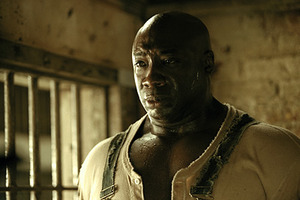 Image: courtesy, IMDB
If you've ever seen the movie The Green Mile, you know that a falsely accused empath named, "John Coffey," literally inhales the pain of those who are suffering around him. As he breaths in their affliction, the lights in his prison cell surge brightly with supernatural electricity as John Coffey swallows the misery of suffering souls. He carries what they can't. And it costs him, as it does all those who have extraordinary empathy.
Psychologists call this kind of emotional engagement, "attunement." It's the ability to dial-in to another's emotional states, to quite literally feel what they feel, to get in-sync with them. It's how we, "Bear one another's burdens." (Galations 6:2)
Ways to get in-sync with those you love
It starts simply by asking ourselves, "What must this person be feeling? What is their body posture telling me: Are they slumped over? Tense and rigid? What emotions are showing up on their face and in their tone of voice? Wide-eyed with fright? Do they have that far-away stare that says, "The feelings are so overwhelming that I can't feel them myself"?
Finally: If you haven't had a chance to watch The Green Mile, it's one of the best portrayals of the Gospel in film.
..........................................
Source:
1. The Mystery of Spiritual Sensitivity, by Carol A. Brown; p. 23
Thursday, October 12, 2017 at 3:26PM 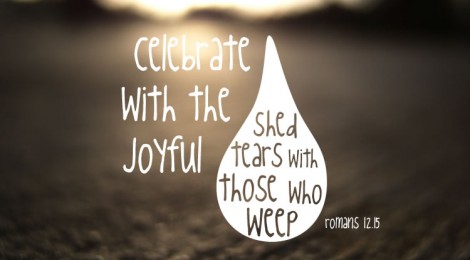 Image, courtesy: saltwaterandhoney.org
"Often, church is the one place we have been trained not to weep." - Life Model Works
I've never had someone weep for me as this man did: not merely weep for me; but as if he was me.
The man who wept for me was my childhood friend's dad, whom I'd known for almost 30 years. A soft-spoken psychiatrist with a dark bushy beard, and a storyteller. But it wasn't his psychiatric training that kicked in that day; it was his sensitive heart.
His wife knew I wasn't doing well; offering to pray for me with her husband. We found a small, quiet room at the conference hotel. I felt painfully isolated and relationally severed. I was a single pastor in a world of increasing losses.
In that small room, the husband and wife pulled up chairs beside me. As we moved out of conversation into prayer, she began praying and he sat to my right, quiet.
As my pain surfaced, the happily-bearded man I'd known for 30 years reached around my back with both arms; wrapped himself around my shoulders like a thick bearskin mantle, and held me. He was slumped over me with grief; his thick dark beard brushed against the back of my neck as he wept. Giant and gentle was his weeping presence. It would be more accurate to say he softly groaned rather than cried, as his anguished tears fell onto my shirt. His body was his prayer.
He wept not simply for me, but as if he was me. This was visceral prayer. Physical prayer. Incarnational prayer.
I felt him feeling what I was feeling.1 He heaved "sighs too great for words." This sort of profound connection is called, "emotional attunement." It's a way of expressing, "I get you. I'm not merely with you. I can feel what you're feeling." It's what neurobiologist Dr. Dan Siegel calls feeling felt.
"The point, of course, is that God attunes to us and feels and acts contingently. We influence him through our emotional states...Our problem is that often we do not take ourselves seriously enough to believe we have that much influence on the One who created the universe." 2
1. Anatomy of the Soul, by Dr. Curt Thompson; p. 98
2. Anatomony of the Soul, by Dr. Curt Thompson, p. 101
Monday, October 9, 2017 at 4:00PM Because we are wounded in relationship; we are only healed in relationship.
The reason secure and connective relationships make all the difference is this: relational ruptures sever our sense of attachment to someone important to us. We experience sensations of abandonment, shame and dread when we lose connections that matter to us. Our body's alarm system can become hypervigilent; ever-watching for the next shoe to drop.
Therefore, since the damage occurred in relationship; it must be healed through relationship. Attachment and healthy bonding (or re-bonding) comes through relationship; relationship with others who are safe, present, and attuned to our emotional needs.
An interesting phenomenon occurred during WWII with the children of London, as German bombers showered explosive ordinance over London's dark skies:
Studies conducted during WWII in England showed that children who lived in London during the Blitz and were sent away to the countryside for protection against German bombing raids fared much worse than children who remained with their parents and endured nights in bomb shelters and frightening images of destroyed buildings and dead people." 1
 Children leaving London during the Blitz. Courtesy, Daily Mail.com; "Seventy years on, two-thousand children who fled the Blitz meet again." By P. Harris and B. Hale
The greater loss was experienced by those children sent away from their most meaningful attachments; their families. Surprisingly, enduring raid sirens, images of bombed-out buildings and corpses was a lesser loss than losing the safety of their parents' presence.
Adults also experience wounding when they lose a sense of attachment and connection with those they love. Below is a video demonstrating the soothing power of connection for adults who learn to connect well. Dr. Susan Johnson is a pioneer in the field of Emotional Focused Couples Therapy. Here, she presents an experiment done with a couple who are her clients:
"Our attachment bonds are our greatest protection against threat." 2
Secure relationships become a safe haven for us.
......................................................................
Resources to consider:
Books:
How to Argue So that Your Spouse Listens, by Dr. Sharon May
Created for Connection, by Dr. Sue Johnson and Kenneth Sanderfer
Anatomy of the Soul, by Dr. Curt Thompson
Living from the Heart Jesus Gave You, by Dr. E. James Wilder; et al.
Websites:
Joy Starts Here/Life Model Works website
...............................................
Sources:
1. The Body Keeps the Score, by Bessel van der Kolk; p. 212
2. The Body Keeps the Score, by Bessel van der Kolk; p. 212
Monday, September 25, 2017 at 11:45AM 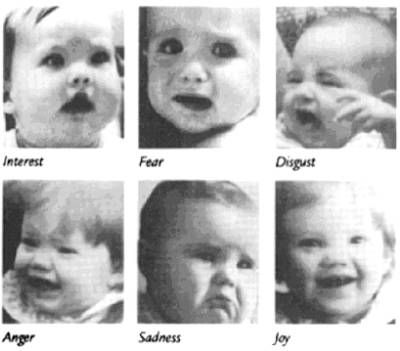 Image courtesy, virtual-lecture-hall.com
A perceptive person can read your face. [Note: Though I'm writing to adults, I've used pictures of infants' faces because their expressions can't be faked; rather than those pictures using actors who are trying to mimic emotional expressions.]
Viewing without seeing
His face bore the rigid gaze of a department store manikin. Eyes open, but not registering. This person across the table from me had been looking at me for an hour as we talked; but I realized that he couldn't see me. There was nothing wrong with his eyes and nothing blocking his view. Yet I felt no more understood than if I was sitting across from a crash-test dummie.
The reason I knew this was because his facial expressions never changed to match mine. There was almost no emotional connection between us because his face didn't mirror my face. There was no reflection of my pain registering in his eyes. No sense that he felt what I felt. Though I had spent an hour with this person, I felt no closer to him.
Reading another's face well makes them feel connected and safe. Decoding another's facial expressions is a critical step in connecting more deeply with them:
[Research] explained why knowing that we are seen and heard by the important people in our lives can make us feel calm and safe, and why being ignored or dismissed can precipitate rage reactions or mental collapse. It helped us understand why focused attunement with another person can shift us out of disorganized or fearful states. - The Body Keeps the Score, Dr. Besselvan der Kolk, M.D.
The face cannot lie. The muscles in the face respond reflexively, automatically to our internal emotional states; especially facial gestures called "micro-expressions:"
A microexpression is a brief, involuntary facial expression that is shown on the face of humans according to the emotions that are being experienced. Unlike regular pro-longed facial expressions, it is difficult to fake a microexpression. 1
Our faces hold the clues to our crime scenes. Dr. Dan Allender, respected Christian psychologist and author, says that each of us is a crime scene. Harm was done to us. It is embedded in our memories and stored in our bodies. So as we "investigate" the harm done to those we care about, we do so knowing that we are walking into a crime scene. Therefore, we walk into each other's stories with humility and honor.
What will their faces tell us?
Responding to their face:
Once you've deciphered a person's facial expression to know what their emotional state likely is, you can serve as a mirror to their soul. "When the message we receive from another person is 'You're safe with me,' we relax. If we're lucky in our relationships, we also feel nourished, supported, and restored as we look into the face and eyes of the other."2
Connecting with the person across from you can be as simple as,
I noticed you look really frightened. If you feel safe, can you tell me more?
It looks like you feel angry right now. Is there something that has hurt you? Is it possible you're not feeling safe right now?
You seem joyful today. How can I celebrate with you?
Note: Hold your assumptions lightly and ask the Spirit to lead. Remember, you could be walking into a crime scene; and that will require discernment.
Final thought? Is it possible that Jesus is really good at reading your face, mirroring your emotions, and offering you a kind response that says, "I get you."?
......................
Sources:
1. "Guide to Reading Microexpressions," Vanessa van Edwards, author and behavioral investigator
2. The Body Keeps the Score, Dr. Bessel van der Kolk, M.D.
Tuesday, May 16, 2017 at 10:31AM I find myself increasingly frustrated with the Church's approach to healing.
From pulpit to prayer group, we assure ourselves that, "God heals the brokenhearted," but don't provide a safe place or sane process for that healing to occur. Simply declaring a truth doesn't necessarily bring it about.
People need a safe place and a helpful process that more deeply engages their story and their pain.
JIM'S OPPORTUNITY:
Perhaps you're like me and long for a caring place to process your story. Here's an opportunity I myself am taking advantage of: This August, I have an opportunity to participate in a potentially life-changing experience with the renowned, Dr. Dan Allender, and his staff: The Story Workshop .
The Allender Center, lead by renowned psychologist and author Dan Allender, offers a Story Workshop for those wanting to engage their own story of wounding and redemption more effectively.
We are all the brokenhearted. Becoming a Christian doesn't magically erase all your wounds. Anyone could benefit from taking a look at their stories of loss and redemption. You can only bring others as far as you're willing to go yourself. Engaging my story in a redemptive manner means I can enter into other's stories of heartbreak and redemption more effectively.
I will not only be engaging my own story of brokenheartedness, but observing the process the workshop uses, and how it engages people's stories. We'll see if God might use that in my own ministry to others.
WHAT IS THE STORY WORKSHOP LIKE?

* 4-day format
* teaching sessions with Dr. Dan Allender
* small groups led by skilled Facilitators
* special one-on-one sessions with your Facilitator
The Story Workshop will take participants like me more deeply into the themes of their life; while offering, "a caring space for you to explore the difficult places where you have felt God’s absence or silence in your life."
................................
HOW YOU CAN HELP ME:
The Story Workshop I want to attend comes with a significant price-tag, particularly for someone like me who is traveling across the country to attend.
Your support pays for my airfare, travel, meals, and the cost of the event. If you'd like to donate, please click the "Donate Now" button on my GoFundMe page; or click the GoFundMe button below. Thank you!

Honor & Delight,
Jim
Monday, June 13, 2016 at 11:51AM 
How is it possible that a person attempting to live from their new heart can remain profoundly stuck? Why is it that even the most disciplined and faithful Christians fear conflict, live from false scripts they've inherited, and suffer just as many relational casualties as non-Christians? What's missing?
One of the biggest barriers to living a free-hearted life - even if you believe that your heart is now good and noble - is unhealed emotional wounding. It is entirely possible to be a New Covenant christian, yet discover areas of your life largely untouched by the transforming power of a new, Christ-indwelled heart. Becoming a grace-filled Christian does not guarantee emotional freedom and relational success.
The mercy of pain
It may take relational pain to alert us to the emotional barriers blocking our new heart: Author Pete Scazzero laments, "Yet now the pain was forcing me to face how superficially Jesus had penetrated my inner person, even though I had been a Christian for twenty years...whole layers of my emotional life had lain buried, untouched by God's transforming power." As disruptive as pain can be, it is [albeit an unwelcomed] mercy.
Becoming more spiritually disciplined will not help. If it could, the most disciplined among us would be the most healthy; and that hasn't proven true in many cases. Some of the most committed and spiritually disciplined people remain unable to relate well or worse, are completely unaware of their emotional and relational impediments.
"Sanctification" has left some of our deepest needs unhealed.
What if "sanctification" includes the healing of emotional wounds? Is it even possible to be spiritually healthy apart from emotional health? Honest experience tells us, "no." Healthy spiritually requires emotional health - not perfection - but a committment to emotional healing.
We know God by knowing ourselves, including our wounds and how they drive our relationships. Though it is also true that we know ourselves by knowing God, it is imperative that wound-care be pursued, leading us deeper into God's love, not farther from it. Augustine wrote, "How can you draw close to God when you are far from your own self?"
Perhaps the "easy yoke" of Christ has eluded us because we haven't brought our whole selves, including our darkest fears and incessant wounds, under the kind affection of Jesus.
Where do I start?
Note: God can heal in a variety of ways. Counseling is only one means. Healing prayer, intercessory prayer, and body-mind methodologies can all be helpful when brought under the discernment and authoriy of Jesus. And in no way am I suggesting the Church outsource all healing to professional counselors. As Larry Crabb suggested in his ground-breaking book, "Connecting," powerful connection can happen between two non-professional people living under New Covenant assumptions.
Wednesday, January 13, 2016 at 5:21PM Why didn't God just start with grace? Why put His people through the Old Covenant Law with it's painfully exhaustive list of "do's and don't's?" Why not go right to the good stuff?
Because the Law had a temporary, but genuinely merciful purpose.
"WARNING, ACTIVE GRIZZLY AREA. STAY AWAY."
Our tour group was pulling over at a rest stop in Denali National Park, Alaska. As we were getting out, our tour guide immediately cautioned that we were in active Grizzly habitat. There was a sign about 300 feet away that read, "Warning, actively grizzly area. Stay away."
If we had chosen to ignore the posted warning sign and gotten between a Grizzly sow and her cubs, the surgeon's needle sowing our scalps back on would have served as a painful reminder just how foolish it would have been to ignore the clear and present danger. Ignorance hurts. Foolishness hurts even more.
Similarly, our medication bottles often come with a warning label saying, "Do not exceed recommended dosage." The label itself cautions that there is something at risk: You. But, "If one pill makes me feel good then five pills would make me feel great!" Maybe so, but the intense vomiting or drug-induced coma that follows will be a painful reminder that sin hurts.
The law was a temporary form of grace. The Old Covenant couldn't offer a cure for foolishness and the even greater pain of trying harder not to be so, but it mercifully made clear the painfulness of chosing against life. Against health. Against wholeness.
We'd beg God to free us from chronic arguments with our spouse, the addiction to emotional eating, the pull of porn that won't let us go. Sin hurts. Ignoring the warning signs hurts. And when it hurts that badly, you want help: When you spin your wheels long enough, you want to stop the madness.
SO THE LAW CREATED A CRAVING FOR GRACE.
"As long as an intense longing for deliverance from sinning has not been wrought, they will naturally fall back into the power of the law and the flesh. The holiness which the New Covenant offers will rather terrify than attract them..." - Andrew Murray
Ask any addict or person who has tried harder to be a better person: Grace is far more attractive to the powerless than it is to the prideful. The Old Covenant Law's painful exposure mercifully ushered in a craving for authentic goodness, a desire to get out from underneath sin's manure pile. Sin hurts. Goodness restores us. We'd beg God to free us from something that had a hold over us.
Law created a craving for grace.
Wednesday, January 6, 2016 at 10:13AM 
Grace is even better than, "God's not mad at you anymore." It's also better than "unmerited favor," or "unconditional acceptance."
In order to control a horse, the headgear that the reins are attached to includes the bridle that fits over his face, and a metal bit that goes into the tender part of a horse's mouth. Those who don't yet know how to intuitively move with a horse often jerk the horse's reins, causing the metal bit to bite into the horse's mouth. This bit-and-bridle method uses discomfort and force in order to get the horse to comply.
Under grace, the "bridle" [Old Covenant Rules] and "mouth bit" [painful pressure] are taken off - removed from the Christian, because the Spirit has given us new hearts that are no longer "prone to wander."
We no longer need bit and bridle to get us to move in the right direction. The horse [we] can move intuitively with the rider [the Spirit].
My book, Recover Your Good Heart, exposes the 'gospel' of pressure - getting jerked around by messages that claim you're a "new creation" but treat you like you're an unruly horse that needs to be "broken."
Tuesday, December 8, 2015 at 10:38AM 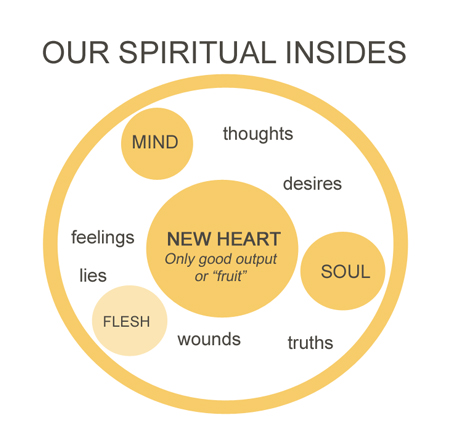
The way you talk about something will either lead to health or increasing pain. There's growing scientific research to suggest that our thoughts [and therefore the way we talk about them] actually have resonance at the subatomic level, something like a signature or substance that moves through time and space affecting the molecules around them. [See Quantum Theory] [1] We know that sound waves move the air and molecules around them. Now we're discovering that our prayers and thoughts do as well. Let's assume how we talk [based upon those thoughts] also carries actual creative power.
Thoughts create. Talking that flows from those thoughts creates. The wrong thoughts and talk create pain.
Most Christians refer to entirety of their inside world as their "heart." Every thought, every emotion, every temptation, every desire gets lumped into the melting pot of their insides, and they call that vast mixture their "heart." Whether bad or good, they mistakenly call everything that takes place deep inside them, their "heart."
It is not so.
When we open the hood of our car, we would never refer to everything we see there as "the engine" because there's also the battery, hoses, and sparkplugs. The engine is but one thing you see under the hood. But because we can't "see" our mind, body and 'flesh;' or take an x-ray of our spiritual insides, our habit of lumping them all together has left us painfully confused.
That's why you can hear a pastor say on one Sunday that he believes we are "new creations" regenerated by the Holy Spirit, but out of his lips next Sunday he carelessly prays, "Let your light come into our darkened hearts this Christmas season." How can you be a "new creation " -- having the new heart God promised through Ezekiel and Jeremiah and affirmed in the New Testament -- yet assume that a Christian's heart remains a darkened heart? No wonder Christians are confused!
The heart is only one part of our insides, and if we get that wrong, we'll believe that all sorts of terrible thoughts and desires are coming from our heart when they're not.
As Christians, our new heart is only one source of thoughts, emotions, and desires within us. The mind is another; so is the "flesh," that ghost remnant of our former lives. We also have an Enemy outside of us that loves whispering half-truths to us, then blaming us for buying into them.
Your new God-given heart [the rootedness of your new identity] can only produce good fruit. So when we speak of any kind of temptation, wayward desires, or addictions swirling around our insides, we must no longer think that all of that mess constitutes the heart or comes from it. No. The mess comes from anything BUT the new heart God gave us when we said 'yes' to Him.
Bottom line: Your new heart isn't the problem. The new heart is the new wineskin for the Spirit. Let's not lump everything inside us under one label, because confusion is painful.
...............................
[1] UpperDogs, Sarah Thiessen & Heather Hughes. The authors, both Christians devoted to restoration, make a compelling case that Quantum Theory provides evidence that both our thoughts and our prayers, especially under partnership with the Holy Spirit actually create new realities.
Wednesday, June 10, 2015 at 5:51PM  Click to listen.
PODCAST: "ARE YOU FIGHTING THE WRONG THING?"
A friend of author Wayne Jacobsen once drew a cartoon where Jesus opened his arms to the masses and said, "Come to me all you who are heavy-burdened and I will give you an accountability group."
The "Christianity" many of us were invited into declares that the battle we face is against the heart, not for it. Why? Because the underlying assumption of a false gospel is that the "heart is deceitfully wicked," even after you've been made a new creation in Christ. We warn each other about the alleged dangers of following our hearts: "Don't trust your heart, it will lead you astray. You have a wandering heart, a divided heart. Reject the desires of the heart. If it's what you want, it probably isn't what God wants."
Certainly discernment must accompany desire: You need to know if a desire is coming from your heart -- and is therefore a noble desire -- or if it's coming from another source. Or it may be that your heart may need mentoring before you rush headlong into something good but untimely. But this is not to say that the Christian's heart is still "deceitfully wicked."
Scripture says, "I will give you a new heart." This is the gift Jesus gave you when you said 'yes' to him. Paul even says, "In my inner being, I delight in God's commands..." [How can he delight in God's commands if his heart, his inmost being, is rebelliously set against God?] He wouldn't be able to delight in God's commands if that was the case.]
When you said 'yes' to Jesus, he gave you his own noble-hearted nature. The irony is, the brand of misguided Christianity that pins the heart to the wall -- so that it doesn't go astray -- actually produces Christians who go to war against the most holy and noble place within them! These mislead souls end up mistrusting their best self! The Christian has then set herself against the very residence of goodness and wholeness God set within her. We quote, "May Christ dwell in your heart through faith" then attack the very heart where Jesus dwells within. So not only are we at war with our best selves, we're at war with God's work; because we've shackled and shut-down the heart of his work, literally. The core of God's work in any man or woman begins by replacing a ruined heart with a royal heart, and we've rejected our own crown.
This false gospel creates a house-divided by...
Don't fight the wrong thing. Fight the Enemy of your heart, the Accuser, but don't wage war against God's throneroom he has set within you. In Christ, your heart becomes your ally, not your enemy.
Friday, March 20, 2015 at 5:12PM 
How far would you go so save your son or daughter's life?
John Quincy Archibald's [John Q] son collapses unexpectedly while running the bases in a Little League game. The diagnosis is a bloated, diseased heart. Doctor's inform John Q and his wife that unless his son gets a heart-transplant, he will die. He won't see his next birthday.
But John Q's health insurance will not cover the boy's heart transplant. It will cost $250,000 to put the boy on the donor list. John can't raise that kind of money no matter how hard he tries. So his dying boy is dropped from the donor list. There will be no rescue, no future for the boy. His enlarged heart will kill him in days.
So what does a father do whose son will die because his heart can no longer give him life? John Q makes a staggering decision...To take his own life, so that his son can have his healthy heart. Transplant by suicide. Life begets life: If the father dies, the boy lives.
"Heart of my own heart."
Grace has never been about God trying to make a bad heart better. That was never an option. Your old heart was failing to give you life, and reconditioning it was never God's plan for rescue. Replacement, not refurbishment. We needed to start over.
There is an untapped vein of gold lying beneath the surface mess. You were gifted with a new kind of heart that no longer needs an addiction. The kind of heart that trusts when there is no comfort. The kind of radiance that doesn't fear the blamers and the shamers.
Grace has never been about making a bad heart better: It's always been about God replacing your heart with his heart. And God has already done this for you. In you. The day you said, "Yes," to Jesus was the day you got your transplant.
There's one prayer the warrior-poet, David, prayed that you don't need to: "Create in me a clean heart, O God, and renew a right spirit within me." David's future hope was your present reality.
You are a donor recipient. Trust the life within you.
Wednesday, February 4, 2015 at 10:43AM The guy confessing an embarrassing porn problem was sitting at the end of the table. A big, burly guy, close to tears. His sordid lust occupied every waking minute of his day: Its trap had sprung, and its iron teeth had shut fast around his heart. The man was a faithful church attender, a solid family man, and took the Bible seriously. But none of it was setting him free from his addiction.
I was on the other side of the table because I was leading the group of men through the Study Guide for my book, "Recover Your Good Heart." Nothing I or the other men said could convince this good man that he was a good man. His addiction had hijajcked his identity.
An undisciplined will? Is he not spending enough time in prayer? Is he not busy enough with Christian service? Is his core problem a wayward nature; a wandering heart? Or should we send him to a counselor to help him manage his addiction? Should he explore any unresolved family history issues?
What if this addicted man's root problem doesn' t reflect any of those typical assessments? What if his root problem is not ultimately resolved through either Christian discipline or therapy?
Author of the book, Connecting, Larry Crabb asks the following question: "What if the root problem in a Christian's life, beneath all the personal, emotional, and spiritual struggles, is unreleased goodness?"
1. Not psychological disorder
2. Not emotional baggage from dysfunctional backgrounds and buried traumatic memories
3. Not irresponsible living [1]
It can often be helpful to gently confront sinful behavior; or to seek counseling or therapy; but often this misdiagnoses the root problem. We don't always need more help with repentance, or analyzing our past; though healing can begin there. We need a small community of a few who have a vision of the goodness beneath our mess - a God-given goodness that is stronger than the mess - with noble appetities that are longing for nourishment and release. This is what the Spirit is up to. That's His invitation.
Our root problem as Christians is unreleased goodness; and we need others around us who have a vision of our [and their own] God-bestowed goodness.
[1] Larry Crabb, Connecting; p. 72
Further resources: My book, Recover Your Good Heart, exposes the myth that the Christian is still "prone to wander," and gives the reader a new vision of an astonishing and practical goodness they already have. A goodness awaiting release.
Thursday, January 15, 2015 at 11:25AM 
The guy in the audience was pretty rude about it: He stopped me in the middle of a seminar I was leading on the Good and Noble Heart and said, "I think you've badly misunderstood the Gospel, sir." His interjection was not simply an attempt to engage me in a meaningful dialogue. It was an indictment. And it nearly derailed the seminar for the other participants. As soon as the event was over, he brushed by me with a scowl that said plenty.
Convictions are like armor: well-plated, protective, and hopefully durable. People don't give up their convictions easily. Nor should they. But you no longer need that armor if Someone stronger is standing between you and your fear.
Why is it so difficult for many people to embrace the message that their heart is no longer "prone to wander: that while they can sin, their most true and authentic self no longer wants to? Why so staunchly deny that Jesus is more interested in freeing their good and noble heart than in pressuring them to be better?
Here's the reason: People are strongly motivated to avoid fear. If they leave behind the 'gospel' of pressure, at best they'll no longer have a checklist to follow that legitimizes their attempt to feel they've done enough; and worse, they fear betraying the pastors who have spiritual authority over them. Nor would they want the exposure of swimming upstream while their church friends are swimming downstream; exposing themselves as a spiritual defector, standing outside the group.
But worst of all, they dread betraying God Himself. And nothing tears at the soul like the belief that you've betrayed "the one who died and gave up his life for you."
A pointy finger warns the questioner, Don't ever betray your spiritual shepherds; and never question God. At the very least, a rebuke will await you; at the worst, Hell will swallow you whole.
Not many are willing to pull the pin on the grenade. The reluctant man has already had too much blow up in his face. But ignorance is not bliss, it's ignorance; and God welcomes a hearty, even heated, discussion; even if it means you have to question the life raft you've been floating in since you were 12. Sometimes you have to leave the life raft so that the Captain can pull you up into the security of his Coastguard Cutter.
Bottom line: Is it worth it to you to risk exposure as a spiritual defector, in order to find out that what you've believed about your heart has been sabotaging it all these years?
*My book, Recover Your Good Heart, carefully examines the biblical argument for the good and noble heart, which a Christian receives immediately when they come to Christ. I also demonstrate that this is not a new teaching, showing the reader there's good reason to take it seriously.
Tuesday, December 9, 2014 at 12:03PM  PODCAST: Friendships and Powerful Connecting.
[What kind of friendships do we need when we're hurting?]
[Podcast text below]
What we try to offer doesn't often work.
When our friend, spouse or child is hurting, is it enough to offer a listening ear? To mirror our hurting friend's feelings through an empathetic, "I can't imagine how you must be feeling, but I'm with you in this?" No. Our experience tells us that as encouraging as those responses can be, it's often not enough to actually heal us. Frankly, as a "high-sensitive," empathy-driven person, I want empathy to be enough; but I have to admit it often isn't.
Should we assume a stubborn will is at the root of our friend's struggles, suggesting she more diligently apply certain biblical principles to her situation, holding her accountable? Again, experience tells us our efforts to exhort a hurting person often do more damage than good.
A better way to relate
Larry Crabb suggests that rather than a moralist model ["Do the right thing"] that assumes a stubborn will is at the root of a person's problems [and can be solved through pressure and accountability]; or a therapeutic model ["Fix what's wrong"] that assumes that psycholocial damage is at the root of a person's struggles [and can be solved through probing, insight and building self-awareness], Larry Crabb offers a third alternative: powerful connecting. When we powerfully connect with another, the actual Spirit of Christ is poured out of me into you, offering what's most alive [and God-given] in me for your greatest need.
Note: There is a limited place for both exhortation and insight, but not at the center of our efforts to heal people. Only powerful connecting can bring the healing friendships we long for.
When you see me struggling, I fear that...
When you see me struggling [says Crabb], realize that my worst fear is that I'm nothing more than a struggler, that nobody can see anything deeper in me than my sin and pain because that's all there is, that my only hope is to sin less and to somehow feel better. Don't put yourself under the pressure to figure out what I should do. That will confirm that my only hope is to do more right things [moralistic model]. I've tried that. It doesn't work.
Don't play amateur therapist or quickly send me to a real one [therapeutic model]. You'll just intensify my search to find out what's wrong with me, and I'll likely become more self-preoccupied and Spirit quenching than ever. And don't merely be nice and promise to pray for me. You can do more than hug me and go through the motions...
When you see me filled with doubt and self-hatred, when you observe me during my worst seasons of discouragement and failure, I want you to be filled with both anguish [weep with me as I weep] and hope, not the empty hope that says trite things like "It'll all work out" or "Just hang in there -- I'm sure you'll feel better soon," but a hope that exists because it sees something in me that is absolutely terrific. Believe that there is life in me. I want to catch the gleam in your eye that tells me you know there is more to me than my problems and that you're confidently hopeful that the good will emerge.
~ from Connecting, by Larry Crabb
What I want from a friendship
Here's what I want from my friendships, and from myself as I hope to offer powerful connecting: Believe that there is a Christ-given vein of gold, a God-bestowed noble heart beneath my mess, patiently believing that the good in me will always be more powerful than any bad no matter how it's masked or buried. Then ask God, "Pour into my hurting friend what is most alive in me into him; giving both me and my friend the hope that powerful healing can and will be released as I follow Your lead."
Point: Powerful connecting occurs when Christ pours what is most alive in my new heart into you, in a way that heals rather than merely offering empathy, pressure, advice or insight.
Related posts: