What readers are saying about Jim's book...


"With profound insight, compassion, and solid biblical support, Jim resurrects one of the most forgotten and overlooked truths in our day."

~Dwight Edwards, author and advisor to Larry Crabb


"This book is life-giving."

~Fran M.; Portland, OR

*Read more reviews on Amazon...

Jim's speaking events

Jim will be speaking in Jaffrey, NH:


Dates:  May 13, 27; June 3. 10, 17


"Recover Your Good Heart"


good and noble heart resources


Get Jim's Newsletter

LISTEN OR WATCH
THE GOOD AND NOBLE HEART MUG


CONTACT JIM
Follow this blog.
Search this blog


Sunday
Jul102011

Kindle Version now available: "RECOVER YOUR GOOD HEART" by Jim Robbins

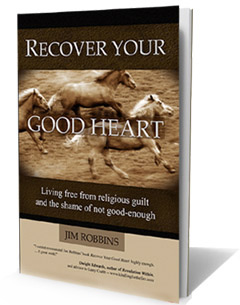
My book, Recover Your Good Heart - Living free from religious guilt and the shame of not good-enough, is now available in Amazon's Kindle Store.  Click here to view.


"I cannot recommend Jim Robbins' book Recover Your Good Heart highly enough...A great work!"

-Dwight Edwards, advisor to Larry Crabb
and author of Revolution Within

Thursday
Jun302011

Enjoy your new nature.

“If you ask those who have made a commitment to Jesus Christ what the Christian gospel is, you will probably be told that Jesus died to pay for your sins, and that if we will only believe he did this, we will go to heaven when we die.  In this way what is only one theory of ‘atonement’ is made out to be the whole of the essential message of Jesus. Justification has taken the place of regeneration, or a new life.” 

-- Dallas Willard, The Divine Conspiracy.

   Many Christians think that most of the significant transformation of their souls will occur either later in their lives when they finally get how to be a good Christian, or "in heaven."  There's always this sense of "I'm not enough yet.  I need to become more_______________." 

This incessent assumption that you are so devoid of goodness and Christ-like character that you can never rest until you are more spiritual [and therefore supposedly more pleasing to God]  sabotages the dramatic work Christ has already done in you. 

Our mistaken understanding of the “new birth” is that it is something primarily reserved for heaven or the spiritual elite.  We have made the Gospel entirely about Justification [getting your sins forgiven so that you can go to heaven] and assumed that Sanctification will happen ... someday.  Hopefully.

The idea of "regeneration" -- that our hearts have already been made new and holy -- rarely gets spoken about in many circles.  Even a noted evangelical like J.I. Packer has said regeneration is:

“the spiritual change wrought in the heart of man by the Holy Spirit in which his/her inherently sinful nature is changed so that he/she can respond to God in Faith, and live in accordance with His will" (Matt. 19:28; John 3:3,5,7; Titus 3:5).

This dramatic change in our nature and tendencies from sinful ... to holy has already occurred.  This is not a new teaching.  God has met his promise:

By this new covenant (new way of relating to God), “we have been made holy through the sacrifice of the body of Jesus Christ once for all.” (Heb. 10:10) “…for he purified their hearts by faith.” (Acts 15:9)

Enjoy your new nature!

Friday
Jun242011

Isn't Jesus' being good for us all we need?  ...No.

I've been asked whether or not it really matters that Jesus gave us a thoroughly good and pure heart when he rescued us.  After all, isn't it enough to know that he lives in me, and that his goodness dwells in me?  Why do I need to be thought of as having a good and noble heart now?

No.  First, Jesus won't simply be good for you [on your behalf].  His desire was to restore your heart so that it possessed the same purity and goodness his does. You can't mature as an individual, unique person if you don't possess a goodness that is now yours.  Yes, that goodness comes solely from Christ's work in you and for you; but nevertheless, just as I need to allow my own children to grow up in the strength I nourish in them -- so that it becomes their strength -- so Jesus must give us a new heart so that it becomes our strength.  He no longer wishes us to merely borrow his goodness.

Why would he merely live in you, without dramatically changing the core of your being first - without addressing the problem of the heart itself.  As goes the heart, so goes the person.  He had to first clean the inside of the cup.

Jesus intent has always been to rescue the heart.  You can even see this in the Prophets' own writing.  Ezekiel 36:26 even predicts Jesus's restoring work of the heart.


THE RUINED HEART:

  • "The heart is deceitful above all things and beyond cure.  Who can understand it?"  [Jer. 17:9]
  • Your heart was your enemy.


THE RESTORED HEART:

  • I will cleanse you from all your impurities and from all your idols. 26 I will give you a new heart and put a new spirit in you; I will remove from you your heart of stone and give you a heart of flesh.  [Ezek. 36:26]
  • By this new covenant (new way of relating to God), “we have been made holy through the sacrifice of the body of Jesus Christ once for all.” (Heb. 10:10) “…for he purified their hearts by faith.” (Acts 15:9)
  • Your heart is now your ally.


Thursday
Jun162011

C.S. Lewis on what makes the enemy so nervous...

My good friend and ally, John, and I were noticing that just about everyone we know -- especially people on the front lines of Jesus' mission to rescue hearts -- was in deep pain or entrenched suffering of some sort.  It's almost uncanny that so many of our allies are suffering;  and it can't be explained away by, "Well, everyone goes through something now and then:  that's just the way it is."  [That sounds a bit naive to me.]

John brought up the following reference from The Screwtape Letters, by C.S. Lewis.  Uncle Screwtape, the elder devil, is telling his nephew the very thing that makes evil itself nervous:

“Sooner or later he [God] withdraws, if not in fact, at least from their conscious experience, all supports and incentives.  He leaves the creature to stand up on its own legs—to carry out from the will alone duties which have lost all relish…He cannot “tempt” to virtue as we do to vice.  He wants them to learn to walk and must therefore take away his hand…Our cause is never more in danger than when a human, no longer desiring, but still intending,  to do our enemy’s will, looks round upon a universe from which every trace of him seems to have vanished, and asks why he has been forsaken, and still obeys.” 


― Uncle Screwtape.  From C.S. Lewis, The Screwtape Letters


  •  "..to carry out from the will alone duties which have lost all relish." 


  • "Our cause is never more in danger than when a human, no longer desiring, but still intending,  to do our enemy’s will, looks round upon a universe from which every trace of him seems to have vanished, and asks why he has been forsaken, and still obeys.”

If you've ever read my blog or my book, you'll know that I've never been one to advocate robotic duty or heart-less obedience; and I'm not sure Lewis is either here.  At first blush, this may paint a rather unfavorable view of God, but note the following:

  • Lewis does not say that God has left the creature – but that in our “conscious experience” it seems that way. 
  • He also doesn’t say that he takes away his presence in these times, but only his hand – so that we can walk when we didn’t think we could; or at least in a strength and capacity we have not ‘till now walked. 
  • It also doesn’t say that we have been forsaken, only that the creature "asks why he has been forsaken,”  given the agony of his experience.

What makes the foul ones nervous?  When an ally of Jesus keeps getting back up, refusing darkness the opportunity to gloat, and continues in desire-less plodding to carry hope into the Babylonian lions' den.  Or to reach Mordor where the one ring will be swallowed in fire forever.  Only then can Frodo go home.  And for such a time as this, to face-down the king who has enslaved her people, exposing the plot, setting off a redemptive sequence in history that far outstrips Esthers diminuitive status.

"Take heart...for I have overcome the world."  And because you are his ally, you are overcoming the world as well."


Friday
Jun032011

VideoBlog: "Developing a Steady Confidence" --Jim Robbins

Thursday
May262011

Developing a steady confidence. Lessons from a Navy Seal

Before his grueling Navy Seal training, Eric Greiten, author of The Heart and the Fist, got into the boxing ring.  He trained with a much more seasoned boxer and his coach, and this is his account of the first days of his training for the ring.

When we finished our day's work, I went into the locker room and took off my new gloves and my new hand wraps.  I held my hands splayed in front of me and looked at my knuckles.  The skin was torn from punching on the heavy bag.  Scar tissue would start to grow soon.  But for now, I savored blood on my hands, the small cut on my lip, the soreness in my jaw.  I had begun to earn the strength that comes from working through pain and it felt good.  I filled the sink with hot water and sank my hands.  When I pulled my dripping hands from the water, hints of fresh blood came to the surface of each knuckle.  ...I was becoming stronger and I liked it.

Deciding to enter the strict and discipled training of a professional boxer, Greitens says he needed to test himself:

" ...I needed to live through something hard and real to become better."    He noted that the other, more seasoned boxers had "a sure sense of how to walk in the world.  That was something I wanted - the steady confidence that comes from passing through tough tests." 


That "sure sense of how to walk in the world...that steady confidence" will often only come with bloody knuckles, cut lip,  and the wind knocked out of us.  But the strength will come, too.  When seasoned through suffering, a fighter can then handle opponents that once would have beat him silly.


Monday
May232011

Video: God Without Religion -- from Andrew Farley

I'm looking forward to reading this newest book from Drew Farley, author of The Naked Gospel.  If you liked my book, Recover Your Good Heart, his books will resonate with you as well.


Thursday
May122011

What am I here to disrupt?

Do you consider yourself a disruptive person?  Do you even consider being disruptive a good thing?

...Not obnoxious, not pursuing an agenda at all costs, not combative; yet stirring, compelling.  Not acting out of a wound, but acting in order to heal.

Here's the point:  If you're going to make a sustainable difference, your presence in some way may well be disquieting to others.  It may come through the choices you make that break pattern with the unquestioned status quo.  It may come through the questions you ask that challenge current embedded assumptions. 

But sooner or later, because your presence is disruptive, someone will notice and find a deeper and truer life because you stirred something in them.  The clothes in the laundry will only come clean if the agitator in the washing machine is working.

You can use the following question to help you focus your disruptive mission:

"How can I disrupt the ______________________  [in the arena I hope to influence, or kind of people I'm most capable of reaching?]"

As a writer answering that question, I ask: 

"How can I disrupt the damaging assumptions Christians have about their identity?" 

And, as a professional musician/artist, I ask:  "How can I disrupt the Church's endorsement of mediocrity so that we can offer the world something more remarkable, reflecting the creative brilliance of Jesus himself?"

How would you answer the question?


*The disruptive question originates with Jesus, but can be found in a book called, Disrupt, by Luke Williams.

Monday
May022011

The irrational hope of suffering

Many of my friends, and even my own family, are going through exceptionally hard times these days.  We're wondering why God seems to be indifferent, almost callous.  God seems to treat us in a way we'd never treat our own friends and family.  My wife and I are questioning every major decision we've made in the last 2 years, wondering if God's promise was a joke.

Would you allow your son to feel abandoned?  You're daughter to experience unrelieved pain?

I'm pretty good at trusting God when I know what he's asking me to risk.  If I'm unmistakeably hearing his counsel, I know he intends on rescue in one way or another.  But when I can't hear a thing - no direction, no counsel, no One ... It is then that trust is forced into a deeper place:

Will you trust me when you hear nothing -- when the knock on the door isn't answered.  When the storehouse is barren.  When the promise feels like a slap across the face?

I'm learning that the only way to move from a theology of hope and trust, to a quake-proof, threat-defying confidence is to let it play out.  Remember:  things are not always what they appear to be.  Our assumptions about what is going on may be inaccurate.  We need to let this play out so that the confidence Jesus had in the bow of the boat being bullied by wave and wind becomes ours.  We need this trial so that the goodness of God's heart - deeply for us -  can be exposed:

There are many truths of which the full meaning cannot be realized until personal experience has brought it home.  - John Stuart Mill

This isn't a stone-hearted dismissal of loss and pain, the kind of unaffected counsel Job's friends offered him.   Rather, know that I'm heart-sick at the level of suffering some of my dear friends and those closest to me are experiencing.  My own family feels tossed about like a dog's chew toy --  Daily rage against unanswered prayer, tears wept as I stand behind my house hunched over in abandonment.  

Then there are the fleeting moments of ever-increasing strength.  A growing noble courage I don't think I've ever felt before. 

My hope is being coaxed, hardened and honed because of the suffering, and not in spite of it.  I don't want to cower before every threatening cloud.  I don't want to be tossed about by every wind:  but I will be unless I allow this chapter in the story to summon a strength that is becoming indominable, not fooled by circumstance and reason.

Share your story.


Monday
Apr252011

Indulge Your New Nature

A friend of mine told me that because of the message he was hearing in church each week, he expected to sin.  He didn't expect to love well, follow in Christ's footsteps, or live in the strength of the Holy Spirit.  He expected to sin.

His Christian leaders taught him to expect that.

And this is the message being offered most Christians on any given week.

It's like a Christian suffering with an addiction,  confirming the worst [and least important] thing about him at the weekly meeting:

"Hi.  My name is _______, and I'm an alcoholic."

Stop right there:  Your behavior and struggle is no longer a reliable indicator of your identity.  No matter how it feels to you, you are under a different, more powerful influence. 

The problem with the expectation to sin is that it contradicts the already-remarkable work of Jesus in the Christian.  Rather than fearing we'll indulge dangerous desires, seductive temptations, or selfish ambitions, we ought to think about indulging our new nature. 

  • Bing on our new goodness.

  • Dote on our new, God-given passions and desires.

  • Cater to our circumcized hearts.

  • Nourish our new purity.

  • Pander to our new heart's super-natural potency.

By the way, this is exactly what the Holy Spirit is up to in you:  he is releasing the new and noble goodness he's birthed in your new heart.  He's inviting you to the bash he's throwing there and waiting to see what kinds of unadulterated love gets stirred up in you, spilling and splashing onto those who need your life.  Your new heart is a wellspring of life cascading out and advancing into barren places.  Indulge your new goodness and let it come out and play.


Thursday
Apr142011

Packhorse Christians

Lithograph image, courtesy Degrazia.orgWhen I was serving in the organized Church - first as a pastor, then as a contemporary worship director, it didn't take long for me to notice that utility replaced desire as an indicator of calling.  In other words, "You are here to do whatever needs to be done."  If there's a need, you will fill it.  If the leadership has told you to do it, you will, or risk being downsized.

Usefulness, replaced desire.  It didn't matter that you were endowed with unique desires that indicated a unique calling.  What mattered was that you filled a need - any need - that came across your path. 

I call this the "packhorse" model of ministry: 

"Just carry whatever load you are asked to, whether or not it has anything to do with your particular gifts, dreams, or desires."  All that matters is that the ministry machinery is kept going.

In the packhorse model, people get used.  You're a burro, a donkey for the organization.  It depreciates people who could be making a far greater impact doing what they were designed to do, and turns them into beasts of burden.  A tragic misuse and misplacement of divine giftings and desires.

The horse wants to run, but the organization wants to keep it tethered:  Mustangs don't belong in the corral where the spirit is broken and the steed is altered to become a drafthorse. 

We need permission.  This doesn't mean that we act alone, ignorant of the common good - It means we aren't simply a part of the machinery.  Your calling isn't about becoming more and more domesticated so that you can please the higher-ups. 

You will find your calling through your heart's deepest desires:  Pay attention to them, for in them God has tied ribbons to trees to mark the way back to the wild purpose of your life.


Friday
Apr082011

We've been taught to mistrust our desires.

We've been taught to mistrust something God himself has given us:  desire.  All desire.


Here are some common assumptions Christians have often made about their desires and passions, and those assumptions have actually prevented Christians from discovering God's will:

  1. Your desires will get you into trouble.
  2. Your desires are inherently selfish.
  3. Your desires are naturally in opposition to God's will.

We love to quote James 1:14

...but each person is tempted when they are dragged away by their own evil desire and enticed. 15 Then, after desire has conceived, it gives birth to sin; and sin, when it is full-grown, gives birth to death.

No where in this passage does Scripture say that all desire is bad.  In fact, in other places, God actually endorses our desires:

May he give you the desire of your heart and make all your plans succeed...May the Lord grant all your requests.  - Psalm 20:4

You have granted him the desire of his heart and have not withheld the request of his lips.  - Psalm 21:2

In fact, Jesus' work in the blind beggar's life  started with, "What do you want me to do for you?"  - Matt. 20:32

Let's be clear:  There are desires of the flesh that can lead us into trouble; and there are whispers from the dark that can entice us.  But the desires of our new heart are good and noble.  As God redeemed our heart, so did he redeem the deep desires of our heart.

Try this:  Allow Jesus to ask you, "What do you want me to do for you?"  What if Jesus is trying to "entice" you with a brand new set of appetites and desires he's already placed within your heart?


Friday
Apr012011

New video: "THE LONG DESIRE"

What have you done with your desires?  Can God be trusted with your deepest longings?  Can a Christian trust the desires of their heart?  Yes!

New video from THE GOOD AND NOBLE HEART MEDIA:

Podcast:  "THE LONG DESIRE:"
The podcast is paired with the video and is for those hungering to learn more about desire and their good and noble hearts.  God has given us permission to desire.  Our heart's longings matter to him.  Can we trust him with our heart's longings even amidst setbacks? Can obedience and desire co-exist?

This audio is excerpted from Chapter Nine of my audio book, Recover Your Good Heart


Monday
Mar282011

Podcast: Permission to Desire

Podcast: "THE LONG DESIRE:"  What have you done with your desires?  Do our heart's deepest longings really matter to God?  Can obedience make room for desire?  Yes!

The following podcast is excerpted from Chapter 9 of my audiobook, Recover Your Good Heart.


As many of you know, my creative side also shows up through music.  I've been a professional musician for many years and recently wrote a video music score for an upcoming video, "The Long Desire."  You can hear the music for that video here.


Tuesday
Mar222011

What is your war-craft?

I wear a ring on which is carved the Roman numerals CXLIV.  It stands for 144 ... Psalm 144.

Psalm 144, verse 1:
Praise be to the Lord my Rock,
who trains my hands for war,
my fingers for battle.

What I do - my mission, my artistry, my craft is my war-craft.  Through the music or videos I create, the intended effect is to disarm darkness through beauty and art; joining God in restoring the life that has been lost.  Art, done in partnership with God, is an act of redemption.

Through the pen and written word, my intent is to expose beliefs that keep people in the dark, bound like Lazarus in his grave clothes. 

What you do, both on and off the 'job' is your war-craft:  You may be a receptionist, an engineer, a web-developer, a poet, or a parent.  Your craft is dangerous...for good.

Your art is an act of war.  When God created you, he was declaring war because you are his redemptive act...his redemptive art.

Your craft and calling matter because they are opposed. 

So the question is,

"In what way is your calling, "artistry" or craft waging war against the dark? Who is it rescuing?"


Friday
Mar182011

Review: SEARCH AND RESCUE

Here's my review of the new book, SEARCH AND RESCUE, by Michael Thompson:

Disorientation is rampant among contemporary Christians [and it’s not their fault.]  Our attempts to become biblically-centered, faithful students of Scripture who can drill down deep, exegete, analyze and dissect, have often left us with a hodge-podge of beliefs, sermon sound-bytes, and scriptural fragments—much like dissected and disembodied specimens in a biology lab that clutter the work bench, but no longer form a body that’s whole. 

We've lost the story-line.

We need a Story to help us make sense of the scriptural shards and spiritual sound-bytes. What we have now is a random page torn from its context:  What we need is the whole story.   We are bloated with information but starving for an interpretation that binds the random scraps together.

A loss of situational awareness can get a hiker killed:  Like Christopher McCandless [Into the Wild] venturing with youthful hubris and naivete’ into the unforgiving Alaskan wilderness, we’re woefully unprepared for this journey.  The unprepared quickly become the unconscious.  [McCandless’ body was finally found inside an abandoned school bus deep in the Alaskan wilderness.  He died alone, stranded in a wilderness he underestimated.] 

If you know the Story you’ve been dropped into, certain things will become clear to you.  The Story gives you your bearings and restores a significant degree of situational awareness.  Certain things can’t be revealed on this side of the Story, but if you know where the narrative has been and is going, you need not live at the whim of randomness.  Randomness will kill your heart.  The opposite of randomness is Story.  What we need to see is a glimpse of what the Director sees.  Pan back; see what we’re up against. 

Search and Rescue gets beyond the canned religious formulas, bullet-points and “should’s” [be a more faithful church attender, get more serious about spiritual growth, or fad programs] to offer a seasoned perspective you’ll seldom hear in church.  Michael Thompson is a trail guide who knows the terrain and how to help others use a truer map and a more accurate compass.

Search and Rescue, the inaugural book from Heart and Life Publishers, will serve as a refreshing introduction to the Story we’ve been missing, yet find ourselves faced with at every turn.  It exposes the real world we can't see, and desperately need to.   ~ Jim Robbins


Monday
Mar142011

Thin places: Where have you found them?

The ancient Celts believed in “thin places” – certain places in the natural world where the veil between heaven and earth was so thin that it allowed heaven to seep through, whereby the individual could touch another world while still standing in this one --  on a lonely mountain top, a hidden field, a remote island.  These places were portals to the Other World.

This shouldn’t surprise us.  There’s plenty of biblical precedence for this: 

  • The Mount of Transfiguration where the ancient ones meet with the everlasting One.

  • The Jabbok River where Jacob wrestled with a "man" through the night.

  • The Island of Patmos, where the island becomes a staging area for a breathtaking revelation, and John receives instruction for the seven churches from the Living One himself.

  • The warrior-poet, David, is instructed to wait until he hears the "marching in the balsams" before striking out in battle against the Philistine army.  That "marching in the balsams" was the heavenly war host advancing like ghosts through the trees.

As occupants of the near- and- now Kingdom Jesus spoke of, we are literally walking through heaven. Heaven is a kingdom that saturates the air around us as Dallas Willard reminds us: "But it is precisely from the space immediately around us that God watches and God acts."[i]

When he comes to deliver us, he doesn't journey to us from far off, or take the red eye, or fly in from space—he comes from out of the air next to us.

One of the worst ironies in modern Christianity is that we’ve lost a supernatural view of reality.  The God and the Kingdom we speak so fondly of remains hog-tied by our cerebral rationalism, put there by those of us who are comfortable with a predictable “reality.”  "The Kingdom of God" isn't a metaphor – or helpful  idea about 'heaven:'  It as a mysterious and disruptive presence.  It is the "real world."

Where are the thin places where you live?


[i]Dallas Willard, The Divine Conspiracy

Tuesday
Mar082011

Revealing another side of spiritual abuse...

What is spiritual abuse?
To label something as “abuse” is a tricky thing. What constitutes abuse for one person may not for another. However, I’m going to use a definition of abuse that I think fits with our understanding of the good and noble heart.  It comes from The Subtle Power of Spiritual Abuse, by Johnson and VanVonderan:

Spiritual abuse is the mistreatment of a person who is in need of help, support or greater spiritual empowerment, with the result of weakening, undermining or decreasing that person’s spiritual empowerment.

The authors go further:

Spiritual abuse can also occur when spirituality is used to make others live up to a ‘spiritual standard.’ This promotes external ‘spiritual performance,’ …or is used as a means of ‘proving’ a person’s spirituality.


This abuse may not even be intentional, but kills the heart, nonetheless.  And we often don't consider spiritual abuse's impact on our heart and our attempts to live from our new nature.

Here's how I define what spiritual abuse does to our new hearts:

Spiritual abuse:
Demanding that a person live like Jesus, while denying the new heart [and its supernatural resources] that makes living like Jesus possible. Shame and spiritual defeat are the inevitable result.

*This was excerpted from my free e-book called, Enough Is Never Enough.
FREE E-book - "ENOUGH IS NEVER ENOUGH - How spiritual abuse sabotages the heart" - by Jim Robbins

Tuesday
Mar012011

Parts of the Old Testament no longer apply to you.

Some ways of describing a God-follower in the Old Testament no longer apply to Christians.  Many Christ-followers read the the Old Testament today as if Jesus hasn't come. 

We can't simply apply certain passages to ourselves without thinking.  These passages were written to God's people prior to the Cross and the radical change of heart that comes with Christ's indwelling.  

Some ways of describing a God-follower in the Old Covenant are no longer true of you - now that Christ has rescued you. 

1.  For example:  Jeremiah 17:9:

The heart is deceitful above all things and beyond cure. Who can understand it?

Salvation is a rescue of the heart [ -our core self, or nature and tendencies of a person].  Jesus cures the problem of a deceitful and wandering heart by giving us a new, pure, and blameless heart - his own heart/spirit/will embedded in our bodies.  [See Ezekiel 36:26; I Cor. 6:11; Heb. 10:10.]   This new heart, given to us at conversion, was the missing link in our Story.  We needed it in order to reconnect with him:

I will give them a heart to know me, that I am the LORD. They will be my people, and I will be their God, for they will return to me with all their heart.

2.  Praise songs that sing, "Create in me a clean heart..." are no longer necessary.  David's cry [which is everyone's cry] for a good and noble heart has been answered.  So what would David sing now?


3.  The Ten Commandments are no longer a necessary yardstick for the Christian.  This may be surprising for some.  Why?  Because the law has been "written on our hearts."  By living from the Spirit, our new hearts naturally want to do what the law commanded.  External constraints are needed no longer because the internal power and desire to live out the spirit of the law are now active in our deepest selves [our new hearts]. A person who is living from their new heart no longer wants to murder, covet, or make an idol of anything.

As Martin Luther declared:  the "Spirit doth make us new hearts, doth exhilarate us, doth excite and enflame our heart, that it may do those things willingly which the law of love commandeth.”  You now want God's will, despite your flesh's attempts to deny that.

It's like a parent removing the training wheels from a child's bike:  the child no longer needs them because the ability to ride the bike is now within her.

Thursday
Feb242011

Most Christians have a lousy view of "sanctification."

Many Christians have a great view of justification [how their journey with Christ begins] but a lousy view of "sanctification"  [how their journey and Christian maturity continues].  This is because we don't get across the dividing line of the Cross completely:  We're straddling the Old and the New, and it's killing our hearts.  It's almost irrational:  like a dying cardiac patient being offered a heart transplant, but wanting to keep the old one in, just in case.

Here's a helpful video on this from Andrew Farley, author of The Naked Gospel:

Page 1 ... 3 4 5 6 7 ... 18 Next 20 Entries »