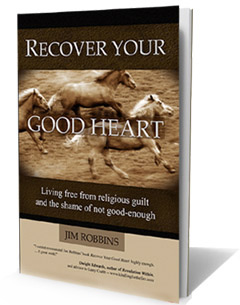








Recover Your Good Heart (on Amazon.com)


"With profound insight, compassion, and solid biblical support, Jim resurrects one of the most forgotten and overlooked truths in our day."

~Dwight Edwards, advisor to Larry Crabb.

"If you have ever been to church and left feeling empty, condemned, tired, or not good enough; this is an essential read..."Recover Your Good Heart" will reveal Biblical truths to you and encourage you to live from your heart. I cannot recommend it more.”

~Meredith: Tampa, Florida
~ Read more reviews on Amazon...

Get Jim's Newsletter

Good & Noble Heart Videos

More Book Resources


Audio book

LISTEN OR WATCH

POINTS OF CONNECTION


CONTACT JIM
Follow this blog.
Search this blog


Entries in shame (10)

Monday
Feb062012

Parents: We are not Correction Officers

I hate to see children who are rigidly controlled like cattle, poked and prodded; or like lab rats, rewarded or punished based upon an adult's perception of successfully meeting expectations.  Control and compliance, the handmaids of shame,  assault my spirit to the core and this is an issue I am currently researching and writing about. 

I thought I was doing much better at stepping back from over-correcting my kids, refusing to control their every decision ...until I tried this little experiment:

Experiment:  Try not to correct your child for a day, or even one hour.  [Unless, of course, there's a safety issue involved.]  Try not to say, "no" or evaluate their behavior.  Don't pressure them to conform to your expectations.  Just connect with them

The experiment was all too revealing for me.  Though I think my parenting has changed for the better in the last few years, and I'm much more conscious of trying not to unnecessarily control my kids, the experiment showed me just how ingrained and reflexive my need to correct them was. 

It's also draining and takes an enormous amount of energy to control others -- energy that could be used to connect with them rather than getting them to comply with our often rigid expectations.


TRY IT

  • Just one day.  Or even one hour. 
  • No corrections, except for safety concerns:  Just connect with their hearts. 

Try it and let me know what you discover.


Related resources:

Wednesday
Feb012012

Video: "Relating Without Control"

Most of our relationships end up being "If ___, then" relationships, based upon control and compliance. We offer love and delight only when our expectations are being met. It's hurting our families and our kids.


Tuesday
Nov082011

How "If____________, then______________" has sabotaged your relationships

Most Christians, most people in fact, live with what one educator calls, ""Compliance Acquiescent Disorder  (CAD)."  An individual with this disorder, "defers to authority,"  "actively obeys rules,"  "fails to argue back,"  "knuckles under instead of mobilizing others in support,"  "stays restrained when outrage is warranted,"  and so on.  Compliance Acquiescent Disorder goes far beyond a proper sense of authority and mutual respect.

I just spoke with a mother today, who told me that her daughter [a responsible kid] was put into time out by her teacher for sharpening her pencil while the teacher was on the phone.  The mother was incensed.

Norm Diamond, who coined the term, Compliance Acquiescent Disorder, was speaking of an educational environment that prizes compliance over almost everything; but C.A.D is an accurate term for what has happened to most of us.  (1)

Most of our relationships: 

  • parent - child,
  • boss - employee,
  • teacher - student,
  • spouse - spouse

operate around an "If __________________, then ___________________" dynamic:

If you behave well, I"ll reward you.  If you misbehave, there will be "consequences."

If you put in over-time at work, you'll receive a bonus.

If you don't complete your homework, you will be penalized."

If you don't meet the expectations I have for marriage, then I'll withdraw as well.


At the expense of our hearts
Because we've gone to schools, worked in jobs, and learned parenting habits where compliance ["Just do what we tell you, whether it's reasonable or not"], always operate around "If ___________, then________," we've gotten used to pleasing others even at the expense of our own hearts.

We've caved,  knuckled under, and refused to challenge the reigning assumption that controlling others and being controlled by others is normal.  It is not.

Our jobs have taught us that workers produce more when there are "carrot and stick" incentives for performance, forgetting that most people want to do good and meaningul work, and don't need to be prodded or "managed" in order to do so. (2)

Our schools have taught our children to comply with every expectation of the teacher -- whether reasonable or not, whether actually good for them or not -- even when it is an assault against our child's will and dignity.

Our inherited parenting habits have taught us to shut down anything messy, anything disruptive, loud or unexpected; oftentimes simply because it's inconvenient for us, or we're just plain stressed. 

"If ___________, then _________________" is everywhere, and it's killing our hearts.  Worst of all, law-based distortions of Christianity have taught us that God only blesses people who comply with his will; and that pleasing him is a matter of getting things right.


(1) From Feel Bad Education, by Alfie Kohn

(2)From "Drive-The Surprising Truth About What Motivates Us," by Daniel Pink


Friday
Nov042011

It's about connecting, not control.

What if, rather than ask,

"How can I get this person to do what I want them to do," we asked,

"How can I connect with this person?"

Getting people [including our spouse or kids] to comply with our rigid expectations will inevitably lead to controlling them. 

Control always leads to shame. 
Why?

Because the one doing the controlling [expecting compliance] assumes it's their right to do so.  It sets the two parties on unequal footing.  The receiving person's dignity is seen as dispensable.

Are expectations a good thing?  Yes.  To live without them is to live without values and to assume our own dignity is indispensable. 

But demanding compliance at the cost of another person's heart isn't acceptable.  God himself is gracious with latitude:  He allows, even welcomes, self-will - the capacity to make uncoerced choices without the threat of disappointing him.

It's helpful to ask:  "Does the person's heart matter more to me than their behavior?"


The controlling dynamic centers around "IF...THEN..."

"If you do this, I'll be happy with you.  If you don't meet my expectations, I'll be disappointed with you."

"If you comply with my expectations, I will reward you.  If not, you'll suffer the consequences."

THIS IS NOT THE GOSPEL.  Instead, God says, "I will bless you on your worst day."


A better way

Jim Collins, author of "Good to Great" and other leadership books, offers an alternative:

1.  "Lead with questions, not answers."

2.  "Engage in dialogue and debate, not coercion."

3.  "Conduct autopsies, without blame."


I would add a couple others:

  • "Give feedback about failed expectations as information, not condemnation."  [remove the emotional sting]

  • "Put the heart of the other person first.  Worry about behavior later."


It's about connecting, not compliance.

Saturday
May082010

'HOW TO SHAME A CHRISTIAN' -- mini-movie

I created this mini-movie to expose some of the wounding, shame-based messages Christians hear. 

Wednesday
Nov252009

'MISLEADING OURSELVES' - today's podcast with guest Andrew Farley

Listen 'live' today as special guest Andrew Farley, author of The Naked Gospel, joins Jim again.  This time they'll talk about the misleading catch-phrases Christians often use -- spiritual language that ends up separating us further from our new hearts and restored identities.  


Airs at 11:30 a.m. EST.  on Wednesday, Nov. 25th.
Click here to go to episode page on Blogtalk Radio.

Monday
Nov232009

LISTEN NOW --new podcast - 'The Heart and the New Covenant'

Joel Brueseke, who hosts the Growing in Grace Together podcast, is a good friend and a guy who really gets the good and noble heart.  Joel interviewed me today for a two-part series.  Here is part one.

Listen in for some great conversation about why Christians tend to walk around in guilt and shame, and why there seems to be such a focus in the church on behavior management and sin management - and how living with a New Covenant mentality rather than an Old Covenant mentality, as well as a proper view of the new heart, will overcome all of that.

Monday
Sep212009

A better way to read the Old Testament - without shame

For decades, the manner in which I read the Old Testament only furthered my shame.
 
I had forgotten to make the critical shift from the Old Way to the New Way--  the old heart to the new heart.  For example, if you read an Old Testament passage like the one below, and forget that something has changed inside you as a result of Christ's work, what would you feel?

"Create in me a pure heart, O God, and renew a steadfast spirit within me."  - Psalm 51:10

My reaction would be:  "Wow, maybe I should be feeling what David is here; I guess I'm supposed to be confessing my sin, examining my selfish heart and repenting about something.  It sounds pretty spiritual and pretty important.  What, exactly, am I supposed to be feeling bad about?  I'm not sure, but I'd better get to work on this repenting thing and ask God to fix my heart."

The problem with that sort of reaction is that it is out of date.  It is an Old Covenant response to a problem that was solved for you in the New Covenant.  Meaning....David's cry for a clean heart has already been answered in the work on Jesus for you.  You've been given a new and pure heart already because you said 'yes' to him.  (Ezekiel 36:26 -- "I will give you a new heart and put a new spirit in you...") 

As we read the Old Covenant, we must now read it from a new heart perspective (you now have a clean heart that does want what God wants).  We make the shift from guilt and shame...to restoration and freedom of heart.

.................................

For more on this, my book Recover Your Good Heart goes into more detail on what Scripture says about our new hearts.

Tuesday
Aug182009

The full interview - Steve Brown interviews Jim about his book, Recover Your Good Heart

Monday
May112009

Misguided "authenticity"

Here's a quote from a missional church leader I have a great deal of respect for.  However, notice his self-description:  Is it biblical?...meaning, is it a true and accurate description of his identity in Christ?

I consider myself as the most miserable of all human beings, covered with sores, foul, and guilty of all sorts of crimes committed against my King; moved by sincere remorse I confess all my sins to him.  I ask him pardon and abandon myself into his hands so he can do with me as he pleases.  Far from chastising me, this King, full of goodness and mercy, lovingly embraces me, seats me at his table, waits on me himself, gives me the keys to his treasures, and treats me in all things as his favorite; he converses with me and takes delight in my countless ways ....Although I beg him to fashion me according to his heart, I see myself still weaker and miserable, yet even more caressed by God.

There's certainly a lot of grace here, but little restoration.  (At least, not mentioned here.)  What kind of God would pardon a person, then refuse to change them at the most basic level (the level of the heart), so that they need not repeat those crimes; and in fact, no longer have it in their nature to do so?

In fact, God has already met this person's longing to "fashing me according to his heart"  ..."I will give you a new heart."  (Ezek. 36:26).  That new heart is pregnant with new life, new desires, and a new will.  How else would he be able to relate well, if not for a transformed heart?  Sure, it will take time to learn to live from that new and supernaturally good heart -- but that will come. 

I'm concerned with a brand of 'authenticity' and 'realness' out there that takes grace seriously ("You're forgiven and loved"), but is unaware of the gracious gift of a new and radically good heart.  These attempts at being real are noble and certainly well-intended, but have missed the core of the New Covenant promise of a new heart -- a heart on which the ways of God are now written.  Why do we keep rehearsing our mess?

We must be urged to make the shift from external and behavioral compliance to internal and supernaturally-capable desire to love and relate well.  Most Christians are unaware that that shift has already happened ...within their own hearts. The desire and the ability to relate well and love wholly are there.

Let's bring this good news back to the center of our teaching, preaching and relating.  Only then will we see more of the transformation we long for.  Let's stop rehearsing our shame, and begin indulging our new appetites -- the desires of Jesus now resident in our new hearts.
------------------------------------------------------------------