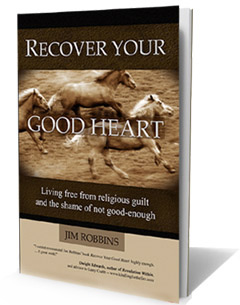








Recover Your Good Heart (on Amazon.com)


"With profound insight, compassion, and solid biblical support, Jim resurrects one of the most forgotten and overlooked truths in our day."

~Dwight Edwards, advisor to Larry Crabb.

"If you have ever been to church and left feeling empty, condemned, tired, or not good enough; this is an essential read..."Recover Your Good Heart" will reveal Biblical truths to you and encourage you to live from your heart. I cannot recommend it more.”

~Meredith: Tampa, Florida
~ Read more reviews on Amazon...

Get Jim's Newsletter

Good & Noble Heart Videos

More Book Resources


Audio book

LISTEN OR WATCH

POINTS OF CONNECTION


CONTACT JIM
Follow this blog.
Search this blog


Entries in New Covenant (6)

Friday
Dec302011

You are just as holy as Jesus.

"You, Christian, are just as holy as Jesus." 
This is an audacious claim, isn't it?

In fact, it's so bold as to feel blasphemous, like an insubordinate and arrogant soldier who doesn't know his place.

But it has to be true if you are to be obedient to Jesus, to love as he loves ... "Love others as I have loved you." 

  • You can't love well without his actual goodness having become your actual goodness.

  • You can't love your abuser like Jesus would, if you have even an ounce of self-righteousness in your heart.

  • You can't love your spouse, kids or friends, without any self-interests, without any expectation of benefit to you, without Jesus' stubborn affection for them.

But here's the difference between us and Jesus: 
Though we as "little Christs" now have the same nature [or "heart"] as Jesus, our actions don't always follow.  It takes time to trust your new goodness, to let it come out and play.   It takes time for the body to follow the heart; for the old habits of our former selves to succumb to Christ's death.

But be confident of this:  Those latent and discouraging habits of mind and body represent a person who no longer exists.  The old has gone, the new has come. 

Your new heart is just as holy as Jesus' heart - because he gave you his own heart.  His good nature is now in you, as you.  You, noble friend are the lighthouse.

Friday
Jul162010

Danger: Exhortation that ignores the new heart

Much of what passes for the “gospel” these days is a message of exhortation without regeneration—preaching that excludes the New Covenant reality of a transformed heart. (Or more accurately, preaching that is grossly unaware of this transformation having already occurred.)

The message of exhortation translated today says, “You’re not doing enough of this; or you’re doing too much of that:” “You’re too selfish, not committed to your marriage, not serving enough …”

Exhortation becomes an attempt to manage (or manipulate) people’s behavior by pressure and guilt, rather than urging them to release the good stored up in their heart through Christ’s work in them.  Exhortation leans toward the 'not-enough' and 'not yet' rather than relentlessly pursuing the  supernaturally-pure heart Jesus has already given us at our conversion.

[Excerpted from my book: Recover Your Good Heart -- Living Free from Religious Guilt and the Shame of Not Good-Enough.]

Monday
Nov232009

LISTEN NOW --new podcast - 'The Heart and the New Covenant'

Joel Brueseke, who hosts the Growing in Grace Together podcast, is a good friend and a guy who really gets the good and noble heart.  Joel interviewed me today for a two-part series.  Here is part one.

Listen in for some great conversation about why Christians tend to walk around in guilt and shame, and why there seems to be such a focus in the church on behavior management and sin management - and how living with a New Covenant mentality rather than an Old Covenant mentality, as well as a proper view of the new heart, will overcome all of that.

Monday
Sep212009

A better way to read the Old Testament - without shame

For decades, the manner in which I read the Old Testament only furthered my shame.
 
I had forgotten to make the critical shift from the Old Way to the New Way--  the old heart to the new heart.  For example, if you read an Old Testament passage like the one below, and forget that something has changed inside you as a result of Christ's work, what would you feel?

"Create in me a pure heart, O God, and renew a steadfast spirit within me."  - Psalm 51:10

My reaction would be:  "Wow, maybe I should be feeling what David is here; I guess I'm supposed to be confessing my sin, examining my selfish heart and repenting about something.  It sounds pretty spiritual and pretty important.  What, exactly, am I supposed to be feeling bad about?  I'm not sure, but I'd better get to work on this repenting thing and ask God to fix my heart."

The problem with that sort of reaction is that it is out of date.  It is an Old Covenant response to a problem that was solved for you in the New Covenant.  Meaning....David's cry for a clean heart has already been answered in the work on Jesus for you.  You've been given a new and pure heart already because you said 'yes' to him.  (Ezekiel 36:26 -- "I will give you a new heart and put a new spirit in you...") 

As we read the Old Covenant, we must now read it from a new heart perspective (you now have a clean heart that does want what God wants).  We make the shift from guilt and shame...to restoration and freedom of heart.

.................................

For more on this, my book Recover Your Good Heart goes into more detail on what Scripture says about our new hearts.

Monday
Jul132009

"There's even more to grace." - podcast archives

There’s even more to ‘grace.’” 9/5/08. Is it possible we’re stilling framing the idea of grace within an Old Covenant mentality? Is there more Jesus is offering us than pardon?

Monday
Apr272009

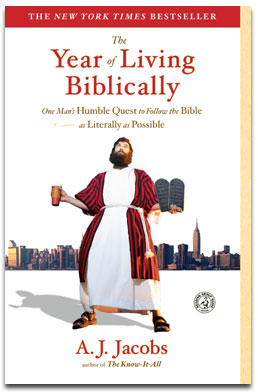
"The Year of Living Biblically" - part II

After a long delay (Sorry, I got distracted), we're moving on to months 4-6 in A.J. Jacob's "year of living biblically:"

The author decides to take the command "Let your garments always be white" (Eccl. 9:8) to heart, wearing, "white pants, white T-shirts, a white sweater, and a white zip-up jacket from the Gap..." like an Hasidic John Travolta.

Though looking a bit like a nomadic pastry chef in his whites, wandering around New York City, Jacobs indicates,

"...the thing is, I'm enjoying it.  My white wardrobe makes me feel lighter, more spiritual.  Happier.  It's further proof of a major theme of this year:  The outer affects the inner.  Behavior shapes your psyche as much as the other way around.  Clothes make the man." 

What do you think?  Is the Christian journey an inside-out life, or an outside-in one?   Is there any truth to Jacob's position on this?  Which one is the New Covenant (new way) Jesus invites us into?