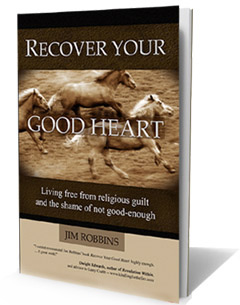
What if your heart is no longer 'prone to wander?' What if God is more interested in releasing a noble goodness He's already placed within you, rather than pressuring you to be more 'holy?' Discover the book by Jim Robbins.
Most preaching and Christian teaching today leads us to expect to sin. Jim contrasts this typical understanding of preaching with a New Covenant/New Heart approach that views preaching as a means of affirming and releasing [with the help of the Spirit] the new-hearted desires, appetites, and tendencies that now reside in the Christian's heart.
New Covenant preaching expects that there is a new-hearted goodness that is awaiting nourishment and release [through community and the Spirit] - a goodness that will grow stronger than any fleshly appetites.
Update on Friday, January 18, 2013 at 4:46PM by
Jim Robbins
BETTER QUESTIONS FOR RELATING TO ONE ANOTHER:
The Church needs to replace the question, "How can I hold this person 'accountable'" with
"Father, how can I celebrate the new goodness you've placed in his/her heart [at conversion], and look for its evidence?"
Another helpful question Christians can ask of each other:
"What is it that's more noble in this person than the surface behavior I see? More noble than the fear? More noble than the brokenness? More noble than the self-protective posture?
Much of what passes for the “gospel” these days is a message of exhortation without regeneration—preaching that excludes the New Covenant reality of a transformed heart. (Or more accurately, preaching that is grossly unaware of this transformation having already occurred.)
The message of exhortation translated today says, “You’re not doing enough of this; or you’re doing too much of that:” “You’re too selfish, not committed to your marriage, not serving enough …”
Exhortation becomes an attempt to manage (or manipulate) people’s behavior by pressure and guilt, rather than urging them to release the good stored up in their heart through Christ’s work in them. Exhortation leans toward the 'not-enough' and 'not yet' rather than relentlessly pursuing the supernaturally-pure heart Jesus has already given usat our conversion.
"Christianity is not about how good we are, but how good God is."
Are we sure about that? [Even raising the question sounds heretical, doesn't it?] As my friend Mike cautions, "Don't poke the bear..." But what if the answer to the question is: It depends on who the "we" is, in that statement.
Part of the problem with preaching today is that it often has to be addressed to a large, diverse crowd, some of whom buy into the teaching of Jesus and some who are cautiously investigating. The speaker/preacher ends up delivering a broad, cast-a-wide-net message that isn't oriented to any particular segment of the crowd [and ends up confusing everybody], or ends up covertly addressing the "unbeliever" in an attempt to evangelize them, though he appears to be addressing everybody. [I used to be in that very position, so I understand the complexities.]
However, to preach or teach and not be clear with the crowd exactly to whom you are speaking [especially when making a statement like the one above] can have a bewildering and injurious effect.
For example, the above claim that: "Christianity is not about how good we are, but about how good God is" is true, but requires a clear caveat. If you're a Christian who hears that statement, you might assume that your heart [your true nature] remains selfish and sinful --because it's not about "how good we are," according to that statement.
This would in fact, be untrue and unbiblical for the Christian to believe. The idea that the human heart is desperately wicked is true -- prior to a person entering the 'in-Christ' life. After Jesus enters the person, he or she has a supernaturally and thoroughly-pure heart [true nature]. This is the classic notion of regeneration.
You can image the confusion many Christians have felt when hearing statements that are non-specific and unclarified like this. The affect of such an unthoughtul approach to preaching (and a misunderstanding of Jesus' rescuing of the heart] leaves many who are technically free, but functionally bound, like Lazarus: Invited into life, but unable to live freely, under the 'easy yoke.' They don't know they've been made radically good; and their spirits break under the weight of poor preaching.
Can you think of other apparently 'Christian' statements that really need clarifying and a deeper undertanding?
................................................................ Related post:
Update on Monday, July 12, 2010 at 3:05PM by
Jim Robbins
If someone were to read only this post and be unaware of my full perspective, they could conclude that I think we ought to condemn the person who has yet to follow Christ, or that Jesus himself approaches people through condemnation.
Nothing could be further from the truth. Jesus didn't approach people this way, nor do I. However, neither can we ignore the conclusion that the heart [prior to Christ's rescuing work] is just as scripture describes -- in ruins, bent inward, unable to love and receive at the level Jesus loves and receives. [ -- what Scripture describes as 'deceitfully wicked.'] As an aside, "deceitfully wicked" doesn't have to look like rape or genocide. It's often much more subtle. -- Remember, Jesus' indictment of the Pharisees is that their righteousness didn't go far enough.]
Just because we want to think all people are basically good [whether Christian or not] doesn't make it so. It's easy to understand how we, in our attempt to make sense of troubling issues, can draw conclusions based upon what we wish was true. But this doesn't get us closer to what is real.
















 Wednesday, January 9, 2013 at 7:20PM